00:00:02 The IIA
The Institute of Internal Auditors presents All Things Internal Audit.
00:00:06 The IIA
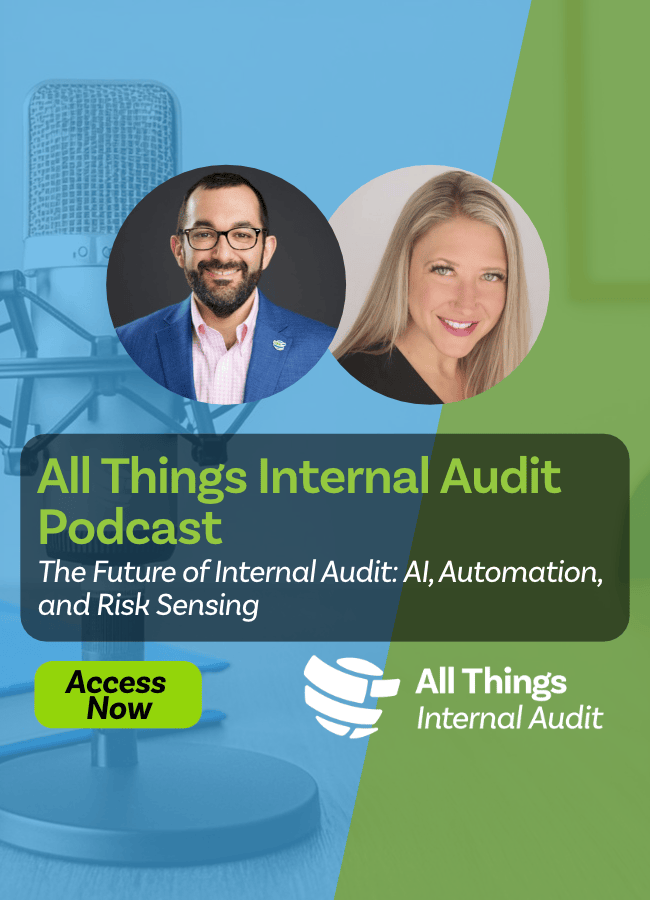
In this episode, Mike Levy talks with Amy Fred about how AI, automation, and business transformation are reshaping internal audit.
00:00:14 The IIA
They discuss how auditors can become involved earlier in organizational change, communicate more effectively with stakeholders, evaluate third-party risk, and identify opportunities for co-sourcing.
00:00:29 Mike Levy
Welcome to the All Things Internal Audit Podcast.
00:00:31 Mike Levy
My name is Mike Levy, and I'm joined today by Amy Fred.
00:00:33 Mike Levy
Amy, welcome.
00:00:34 Mike Levy
We're going to talk about the evolution of internal audit and where we see the future heading.
00:00:37 Amy Fread
Thanks, Mike.
00:00:38 Amy Fread
I'm excited to be here with you today.
00:00:39 Mike Levy
Great.
00:00:40 Mike Levy
So as we look at evolving internal audits, we're in 2026.
00:00:43 Mike Levy
So many things have changed over the last 12 to 24 months.
00:00:46 Mike Levy
Where do we start?
00:00:46 Mike Levy
Where do you see internal audit moving if we look at both 2026 as well as the years ahead?
00:00:51 Amy Fread
I think
00:00:52 Amy Fread
One thing we can't ignore is the impacts of AI and GenAI that are coming down right now.
00:00:57 Amy Fread
Just being at the GAM conference recently, that topic is all over everyone's presentations.
00:01:04 Amy Fread
That's definitely one coming down the pipeline.
00:01:06 Amy Fread
The other item that we can't ignore is how we're thinking about specializations within internal audit.
00:01:12 Amy Fread
Internal auditors are being more of a face of change
00:01:15 Amy Fread
And because of that, coming to the table during extreme business transformations and needing to bring different types of skill sets.
00:01:22 Amy Fread
So when we think about that critical thinking and the ability to connect dots throughout the organization, those types of skill sets are becoming more and more important.
00:01:30 Mike Levy
Yeah, I think it's an interesting point because we're really uniquely positioned as internal auditors, right?
00:01:35 Mike Levy
Internal audit sees the whole landscape of a company from business risk to IT risks.
00:01:39 Mike Levy
And you mentioned AI, but
00:01:41 Mike Levy
Business transformation, I really do believe, is sort of the underpinning of all of this.
00:01:44 Mike Levy
Every organization that I've interacted with has had some level of transformation that they are embedded at.
00:01:50 Mike Levy
Sometimes it's AI related, sometimes it's just process related within the company.
00:01:54 Mike Levy
How do you think internal audit is positioned to?
00:01:57 Mike Levy
help organizations do that?
00:01:58 Mike Levy
Because we always talk about being a trusted advisor and it seems like this is a prime opportunity for that.
00:02:04 Amy Fread
Those words, trusted advisor, are really important.
00:02:07 Amy Fread
We think about the responsibilities, for example, of a CFO these days and the expectations on a CFO to deliver to their stakeholders insights around how the company is performing.
00:02:19 Amy Fread
When you think about how can internal audit show up to help and be that trusted business advisor, whether that's implementing more continuous monitoring to detect risks earlier on or whether that's really coming to the table with insights and advice during those key decision points.
00:02:36 Amy Fread
So while maintaining independence, not making those decisions, but advising on the trade-offs if you do A or B, that's where we really see internal audit showing up to the table.
00:02:47 Mike Levy
So to that point, we look at internal audit and we obviously just had new global internal audit standards released last year and the concept of assurance work that internal audit does as well as advisory work to do some of what you just described.
00:02:59 Mike Levy
I believe internally needs to be involved earlier in the process.
00:03:02 Mike Levy
If you're a CAE or even a staff auditor listening to this, how do you get involved earlier in the process?
00:03:08 Mike Levy
Because so much of our work, it's easy to be looking backwards and coming in at the end, but obviously so much change is happening that the earlier we can be evolved, the greater our impact can be.
00:03:18 Amy Fread
Precisely.
00:03:19 Amy Fread
There's a few different ways that we have seen this be successful.
00:03:22 Amy Fread
And one of the ways that tends to draw the most success is looking at if there's a steering committee.
00:03:29 Amy Fread
So if you're undergoing a major business transformation, most likely of a governance committee that's sitting over top having regular updates, internal audit having a seat at that committee, being able to hear some of the discussion real time and advise on those trade-offs real time, that's where you're going to be there front and center.
00:03:47 Amy Fread
The other thing to think about, we talk a lot about assurance by design, where perhaps you're doing a major ERP implementation is a great example.
00:03:56 Amy Fread
coming in at the forefront and advising from a pre-implementation perspective and then coming in after to see the post-implementation results.
00:04:05 Amy Fread
That is a way internal audit can really help give the business insights in advance before they're coming in and providing that assurance.
00:04:13 Mike Levy
Yeah, it's been interesting even on watching internal audit functions from a reporting perspective as it relates to some of this, because I've seen a lot of functions shift in how they are doing executive management reporting, which I think goes back to the evolution of an
00:04:26 Mike Levy
internal audit function because to your point, I mean, we have to be objective and independent in what we do.
00:04:31 Mike Levy
But sometimes I think the reporting evolution is almost as important as all of the other change that's happening because if we feel like we are the police and we feel like we're the gotcha, then people don't necessarily want to come to us earlier and it sort of comes full circle.
00:04:44 Mike Levy
So when you work with some of your clients and you think about how they are doing their internal audit reporting,
00:04:50 Mike Levy
What have you seen in terms of like what's worked well and not worked well, especially as it relates to some of these business transformation initiatives that we're getting engaged on?
00:04:57 Amy Fread
The evolution of the internal audit report has been really impactful from what I've seen, where internal audit is now saying, this is our work product.
00:05:07 Amy Fread
This is all the organization knows us for.
00:05:10 Amy Fread
The more we can speak the way the organization speaks, the more they seem to listen.
00:05:15 Amy Fread
We've seen a lot of those trends, which I think is a really great
00:05:20 Amy Fread
response because it means people read the reports.
00:05:23 Amy Fread
And the more that we are able to condense those reports and focus on what we did and why does that matter, that's where we see more impacts coming.
00:05:33 Mike Levy
And you mentioned AI adoption.
00:05:35 Mike Levy
I've seen just for the listeners, I've even seen some audit functions move to audio-based reporting in some cases where they issue a report, but then using some of the leading generative AI tools out there, they're converting that to podcast-style episodes that
00:05:47 Mike Levy
audit committee chairs can listen to on the go and things like that just to be a bit more forward thinking so that they're bringing their things to how their consumers want to consume it.
00:05:56 Amy Fread
The AI element that you're talking about is really fascinating there.
00:06:00 Amy Fread
As internal auditors, we have such a unique and exciting position where we don't just look at AI on how it can help us be more efficient, but we're also looking to understand it and the risks.
00:06:12 Amy Fread
it's bringing to our organization.
00:06:14 Amy Fread
So I just think that's a really fun spot for internal auditors to be in.
00:06:18 Mike Levy
So when we look at AI and more importantly, generative AI as an internal audit function, if I'm an internal auditor, how do I continue to deliver value there?
00:06:26 Mike Levy
And thinking about that from, obviously, first a governance perspective within my organization.
00:06:31 Mike Levy
And most audit functions, I think, are trying to figure this out twofold.
00:06:33 Mike Levy
One, how do they adopt it within their internal audit function?
00:06:35 Mike Levy
But then two,
00:06:36 Mike Levy
How do we evaluate that and make sure our companies are adopting it thoughtfully?
00:06:40 Mike Levy
What would you see as best practices there in terms of how they can go about doing that?
00:06:44 Amy Fread
I'll start with your question on the governance side of it, because they really are two separate questions.
00:06:49 Amy Fread
When I think about governance, I go back to how I think about basic internal controls.
00:06:55 Amy Fread
We want to understand the data and how is that data complete and accurate?
00:06:59 Amy Fread
How are we getting confident with the data?
00:07:02 Amy Fread
We also want to think about considerations as it relates to who has access to it.
00:07:06 Amy Fread
How are we managing that change function?
00:07:08 Amy Fread
So when we think about governance, really who's sitting on top making these decisions and what are those fundamental underlying controls for the applications?
00:07:18 Amy Fread
But then on the flip side of your question, where we think about use cases for internal audit, now this is where it gets to be a lot of fun because we can see this going in so many different directions.
00:07:28 Amy Fread
But really looking at this first and foremost of where do you spend the most time?
00:07:32 Amy Fread
What's repeatable?
00:07:34 Amy Fread
What may be some mundane tasks or tasks where if you can accelerate the pace, you're able to generate additional value for the organization.
00:07:43 Amy Fread
That's going to help you in prioritizing your use cases.
00:07:47 Amy Fread
And they may vary by department, by organization.
00:07:50 Amy Fread
on which ones will have the biggest impact for you?
00:07:52 Mike Levy
Yeah, I think it's interesting too, because one of the pitfalls I've seen, obviously the largest of organizations have very robust processes around how they are thinking about governance, but many internal audit functions and organizations that are sort of in the next tier down in size are still trying to figure a lot of this stuff out.
00:08:09 Mike Levy
And one of the things I've encouraged folks to do is
00:08:12 Mike Levy
take incremental steps forward rather than trying to embark on the overall massive project.
00:08:17 Mike Levy
Because sometimes empowering individual auditors to automate some of their processes, to your point, I think has a huge impact.
00:08:22 Mike Levy
And there are so many tools that organizations are now deploying that make it very quick and easy to deliver a ton of value within the function.
00:08:29 Mike Levy
Going, thinking about how functions are adopting some of these things.
00:08:33 Mike Levy
When we think about all of the third-party tools that are out there,
00:08:37 Mike Levy
How can we thoughtfully think about those things and adopt them?
00:08:40 Mike Levy
And where do you see some of the risks that lie with third parties as a whole?
00:08:45 Mike Levy
And especially more importantly, in this new world of generative AI we're living in, there's so many solutions coming out that are very quickly being adopted.
00:08:52 Mike Levy
Where do you, I guess, first of all, what should internal owners do as they're thinking about that?
00:08:55 Mike Levy
And where do the risks lie that they need to think about?
00:08:58 Amy Fread
Yeah, we see third parties are increasingly becoming more of a hot topic in the internal audit space, even beyond the AI Gen.
00:09:05 Amy Fread
AI conversation, because organizations are relying much more these days than maybe in the past on third parties for critical applications.
00:09:14 Amy Fread
When an organization's thinking of selecting a third party, you want to evaluate those supply chain procurement processes to ensure that they are robust in going through the process, that they have the right internal controls in place.
00:09:28 Amy Fread
And then when I think about third parties as well, how are they governed and being managed?
00:09:33 Amy Fread
We're noticing a lot of cost recovery opportunities out there that organizations are embarking on because the governance of third parties has not been as stringent.
00:09:44 Amy Fread
And it's resulted in not only duplicative payments, but a long lead time to catch duplicative payments where you've got cost or payments that have been generated sitting out there with your third parties that you can recover.
00:09:55 Amy Fread
So it's definitely an area to be mindful of.
00:09:58 Amy Fread
And like I said, start with that governance and overarching controls, but then take it that step further to your organization of how can we help think about recoveries here as well.
00:10:07 Mike Levy
Excellent.
00:10:08 Mike Levy
And then when you're working with clients and you're thinking about that, yeah, everybody's trying to make a decision, whether it's a technology third party that they're using or a service provider, the concept of insourced versus outsourced or co-sourced, what kinds of considerations are you helping clients think through around that decision, right?
00:10:24 Mike Levy
Because it's sort of the build versus buy approach to things.
00:10:27 Mike Levy
Do you do it in-house or do you co-source the work and what are the best approaches or the things people should be considering?
00:10:32 Amy Fread
I always think about this and we believe you start by breaking down the different types of work.
00:10:37 Amy Fread
There's certain decisions that...
00:10:40 Amy Fread
would not make sense perhaps to outsource.
00:10:42 Amy Fread
So if I'm responsible for reporting results to the audit committee as an example, I would want to make sure I maintain control of that.
00:10:49 Amy Fread
That's one example if you're an internal audit leader to be considering who is really owning the assessing of the risks and understanding the objectives.
00:10:58 Amy Fread
Those areas are ones you more likely want to keep in-house.
00:11:01 Amy Fread
When you think about bringing in a co-source provider,
00:11:05 Amy Fread
You want to look at where do we need really deep expertise?
00:11:08 Amy Fread
Where do we have a skill set gap perhaps that this partner could help fill?
00:11:13 Amy Fread
And also where do I perhaps need another layer of independence?
00:11:17 Amy Fread
Sometimes being on the in-house side, you may get involved in advising as a transformation initiative has stood up and you want some fresh eyes to come in on that back end and take a look.
00:11:28 Amy Fread
So there's a few different considerations there.
00:11:31 Mike Levy
And then from an IA perspective, we obviously want to make sure we have tangible value in what we're doing, that people can see that.
00:11:38 Mike Levy
When we think about things like cost recovery or how would we measure success beyond the dollars found, whether it's prevention, control fixes, other, how else would we talk to our management teams and our audit committees about that so that they understand the return on the investment that they're making in some of these areas?
00:11:54 Amy Fread
The dollars found always makes me smile because that's the quickest way to get anyone's attention, put a dollar value to it.
00:12:01 Amy Fread
But when we look at long-term value, it's about identifying where is the process broken.
00:12:07 Amy Fread
And internal audits uniquely positioned to truly understand the governance controls that would need to be in place to not only fix those root cause problems, but also speed up your time to recoveries, meaning what are those detective controls if something is not prevented?
00:12:24 Mike Levy
When in some of your, and so I agree completely with that, and when I think about
00:12:29 Mike Levy
internal audit teams.
00:12:29 Mike Levy
I mean, there's so, as we've talked about throughout this discussion, I mean, so many, there are so many changes and it's almost impossible to stay on top of all of the, I mean, quite literally every week there is something new coming out that people need to be made aware of.
00:12:41 Mike Levy
Where have you seen pitfalls from an internal audit function perspective?
00:12:45 Mike Levy
What are some of the things that you've seen and you've said, wow, I really wish we did this, really wish we did this differently.
00:12:49 Mike Levy
And if I were trying to learn what to avoid, what are some of those things?
00:12:54 Amy Fread
At a high level,
00:12:56 Amy Fread
The rigorous process for ourselves that we preach to our auditees tends to come into play here.
00:13:03 Amy Fread
And I say that meaning we have available to us and not just internal audit, the organization as a whole, an abundant amount of data.
00:13:11 Amy Fread
And now we have a lot of tools and technologies to digest that data quite rapidly.
00:13:16 Amy Fread
What we have not perhaps gone to is what do we do then?
00:13:21 Amy Fread
So where we're seeing the most effectiveness is this rigorously managed process for not only identifying where risks lie, but what are the escalation points and what are our thresholds for when this moves up the chain to get addressed?
00:13:36 Amy Fread
And those are some practices and principles kind of at the forefront of the change and adoption that's happening right now.
00:13:43 Mike Levy
Yeah, it's always interesting too, because I think sometimes
00:13:46 Mike Levy
with as much as is changing now, I think sometimes companies are not fully defining when things need to move up the chain and how that communication works and what the taxonomy needs to look like and how they talk about it.
00:13:56 Mike Levy
And I think the more definition that the governance process can have, the better and more thoughtful the approach can be when some of this stuff happens.
00:14:04 Mike Levy
So I agree completely.
00:14:06 Mike Levy
So as we wrap up, I mean, when you think about the amount of change we've seen even in the last 12 to 24 months, and then you look at internal audit five years from now, where do you see the profession and how do you think internal auditors can make sure they are ready for what five years from now looks like?
00:14:20 Amy Fread
I see this really moving to a continuous automation monitoring process.
00:14:26 Amy Fread
internal auditors are going to be data-driven.
00:14:29 Amy Fread
We're moving away from the cyclical audits and we're seeing more trends in a risk focused lens with that automation standing it up.
00:14:38 Amy Fread
I see a lot more risk sensing coming down the pipeline because of the tools and capabilities that we have available.
00:14:46 Amy Fread
And then last, I still see strong themes towards cybersecurity and IT risks as these Gen.
00:14:53 Amy Fread
AI assets further develop.
00:14:55 Amy Fread
So those would probably be my 3 big areas.
00:14:57 Mike Levy
And we probably could do a whole nother conversation on some of the cybersecurity risks that some of this advises.
00:15:03 Mike Levy
Is there anything else you'd like to share with the audience before we go today?
00:15:06 Amy Fread
Nothing else from my side.
00:15:08 Amy Fread
Thank you so much for the questions and the discussion.
00:15:09 Amy Fread
This was really fun.
00:15:10 Mike Levy
Absolutely.
00:15:11 Mike Levy
Thanks for coming and we appreciate all your insight.
00:15:14 Amy Fread
Yes, thank you.
00:15:16 The IIA
If you like this podcast, please subscribe and rate us.
00:15:19 The IIA
You can subscribe wherever you get your podcasts.
00:15:22 The IIA
You can also catch other episodes on YouTube or at the iia.org.
00:15:26 The IIA
That's T-H-E-I-A dot O-R-G.