00:00:02 The IIA
The Institute of Internal Auditors presents All Things Internal Audit.
00:00:07 The IIA
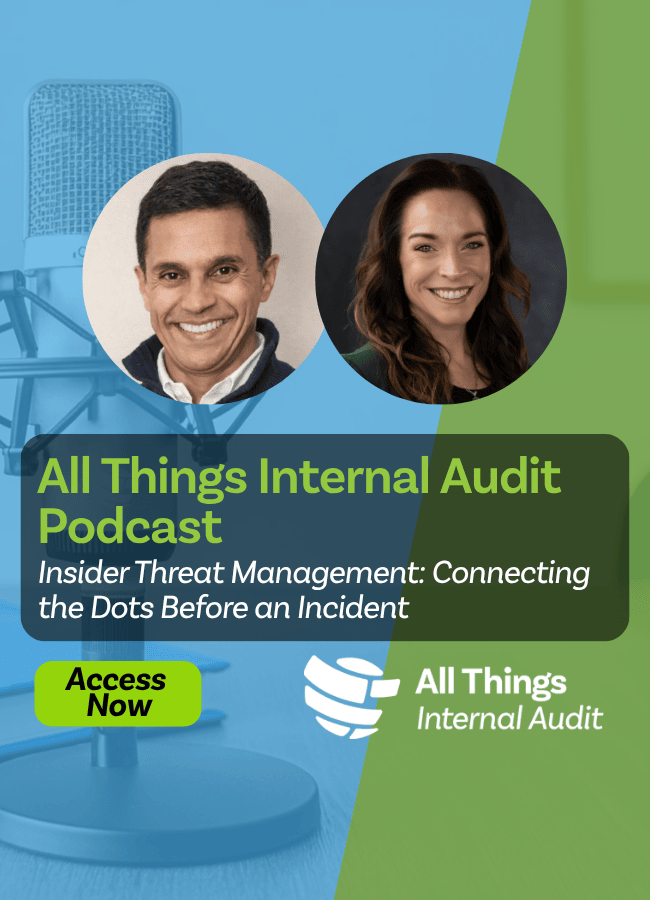
In this episode, Emmanuel Pascal and Dr.
00:00:11 The IIA
Ahmed Shaki discuss why greenwashing is no longer just a reputational risk, but also a governance and assurance challenge.
00:00:21 The IIA
Together, they break down how greenwashing qualifies as legal misrepresentation, why most control environments are far weaker than leadership realizes, and what a practical audit approach looks like.
00:00:36 The IIA
From mapping sustainability claims across channels to using data analytics and intensity ratios to test what companies report and what they don't.
00:00:50 Emmanuel Pascal
For those who are not familiar, Dr.
00:00:53 Emmanuel Pascal
Ahmed, how would you define greenwashing and what could be the consequences for a company?
00:01:00 Ahmed Sharif Shawky
Greenwashing simply to me is misrepresentation of sustainability information.
00:01:04 Ahmed Sharif Shawky
That could be in any form overstating, distorting, or omitting material information about the company's sustainability performance.
00:01:12 Ahmed Sharif Shawky
And that's in practice, companies really cherry pick their sustainability, what they show to the public.
00:01:18 Ahmed Sharif Shawky
showing only or amplifying their positive impact to the public in general.
00:01:22 Emmanuel Pascal
Thank you.
00:01:23 Emmanuel Pascal
And it's very important that you mentioned the fact that there are some information that are omitted, because usually when I hear about greenwashing, I hear about communication.
00:01:35 Emmanuel Pascal
People talking about is what we are communicating is good?
00:01:39 Emmanuel Pascal
Are we going not going to do wrong green claims?
00:01:43 Emmanuel Pascal
So it's
00:01:44 Emmanuel Pascal
They are judging from what is said and not what is not said or augmented.
00:01:50 Emmanuel Pascal
And I think this is very, very important.
00:01:53 Emmanuel Pascal
And there are some very interesting cases where companies have concealed events and not disclose them.
00:02:00 Emmanuel Pascal
It's either in the US, there's a mining company that was indicted for this.
00:02:05 Emmanuel Pascal
And in Asia, there have been some incidents like a milk company in China that have issues and did not disclose it.
00:02:14 Emmanuel Pascal
So that's very important.
00:02:16 Emmanuel Pascal
But at the same way, Dr.
00:02:18 Emmanuel Pascal
Ahmed, I'm very, by the way, I'm surprised we're still talking about greenwashing.
00:02:24 Emmanuel Pascal
I thought it was over as there is a backlash on this.
00:02:28 Emmanuel Pascal
And do you think it's worth working on it?
00:02:31 Ahmed Sharif Shawky
Yeah, the political backlash is real, but it's mainly coming out of the US.
00:02:36 Ahmed Sharif Shawky
Most of stakeholders actually haven't moved and still a strong believer in business responsibility and in business sustainability.
00:02:45 Ahmed Sharif Shawky
So for example, in Europe, regulators here are investors, consumers.
00:02:49 Ahmed Sharif Shawky
They still need credible sustainability data to make informed decisions.
00:02:53 Ahmed Sharif Shawky
So the demand hasn't really gone anywhere.
00:02:56 Ahmed Sharif Shawky
I think it's only the hype and the rhetoric has shifted for some people in the specific regions only.
00:03:02 Ahmed Sharif Shawky
We see, for example, you and I have seen the risk in focus 2026, 2025 still, climate change and regulatory change amongst the highest risks across all regions.
00:03:13 Ahmed Sharif Shawky
But you know, there is a widening gap between, really widening gap between political noise and regulatory reality.
00:03:19 Ahmed Sharif Shawky
And this is where most audit committees
00:03:21 Ahmed Sharif Shawky
really get caught and blindsided.
00:03:24 Emmanuel Pascal
One question I will have, and we are going to talk about fraud after, but how can we consider greenwashing as a fraud?
00:03:32 Emmanuel Pascal
It's how, in what way could it be illegal?
00:03:35 Emmanuel Pascal
Are there laws about it?
00:03:37 Emmanuel Pascal
I know you're a specialist on this type of laws.
00:03:40 Emmanuel Pascal
That's why I asked you.
00:03:42 Ahmed Sharif Shawky
So the greenwashing is legally treated as misrepresentation.
00:03:46 Ahmed Sharif Shawky
The core construct is the same as financial misstatement.
00:03:51 Ahmed Sharif Shawky
We have seen Enron case, for example, that was a financial misstatement.
00:03:55 Ahmed Sharif Shawky
The same construct legally applies to non-financial data, which is sustainability data or business data.
00:04:02 Ahmed Sharif Shawky
When organizations or business make sustainability claims that are false or unsubstantiated, they are misleading the public, the market, the consumers, the investors.
00:04:12 Ahmed Sharif Shawky
And that's clear, clear misrepresentation and regulators are treating it as such.
00:04:17 Ahmed Sharif Shawky
For example, there are three regulations here in the UK for anti-greenwashing.
00:04:22 Ahmed Sharif Shawky
The first one from the Financial Conduct Authority, the FCA, the UK, they have, that's enforced.
00:04:28 Ahmed Sharif Shawky
It's called the anti-greenwashing rule.
00:04:30 Ahmed Sharif Shawky
That's enforced since May 2024.
00:04:33 Ahmed Sharif Shawky
It applies to every authorized financial institution in the UK.
00:04:37 Ahmed Sharif Shawky
And it requires that their financial claims must be fair
00:04:42 Ahmed Sharif Shawky
clear and not misleading.
00:04:44 Ahmed Sharif Shawky
The second authority is the CAM, the Competition and, or CMA, I think, the Competition and Market Authority.
00:04:52 Ahmed Sharif Shawky
Under the Digital Markets and Competition and Consumer Act since April 2025, last year, the CMA can directly now fine companies up to 10% of their global turnover.
00:05:06 Ahmed Sharif Shawky
That's equivalent to GDPR, and no one is noticing really.
00:05:11 Ahmed Sharif Shawky
And the minimum, and the minimum is, I think, 300,000 pounds.
00:05:16 Ahmed Sharif Shawky
Even those penalties happen even without going to court.
00:05:19 Ahmed Sharif Shawky
And there are daily penalties on top of that until the breach is remediated.
00:05:25 Ahmed Sharif Shawky
In January this year, the CMA published the new supply chain guidance where companies are now liable for getting claims, they repeat from their own supply chain, from their suppliers, not just the claims by the originate.
00:05:39 Ahmed Sharif Shawky
Thirdly, and finally here, the Advertising Standards Authority, the ASA, in the UK continues to show also a sustained focus on environmental claims as retailers were using green claims as advertisement campaigns.
00:05:57 Ahmed Sharif Shawky
Those are the three main examples of three main regulations here in the UK alone.
00:06:03 Ahmed Sharif Shawky
And also in addition to that, you have now requirements from the IFRS Foundation within the ISSP about climate changes, specifically GRI disclosures and so on.
00:06:13 Emmanuel Pascal
And as you were talking about GDP, I was thinking, and so everyone knows that the UK are not in the European Union now, but they are also another law in Europe, but it's happening called empowering
00:06:31 Emmanuel Pascal
customers.
00:06:31 Emmanuel Pascal
And I think it's going to be a shock in Europe because some people are not understanding the consequences of this law because it's going to affect sustainability labels.
00:06:44 Emmanuel Pascal
And a lot of companies are labelled for customers, but also for third parties.
00:06:49 Emmanuel Pascal
And also we are going to talk about green glaze for customers.
00:06:54 Emmanuel Pascal
Also, as you mentioned, you mentioned the UK, but there are also a lot of reporting laws in place under development in Asia.
00:07:04 Emmanuel Pascal
I know that China is very hype on developing reporting claims, as you talk about GRI, there are also, and IFRS, there is a lot of development.
00:07:16 Emmanuel Pascal
So I think we talk about fraud, and I'm going to
00:07:22 Emmanuel Pascal
explain what makes greenwashing different from other traditional fraud, classic fraud.
00:07:28 Emmanuel Pascal
And the first thing I wanted to say is that there is a concept I developed a few years ago called the value fraud, and I trained my students in Dauphin University in Paris on it.
00:07:40 Emmanuel Pascal
It's about when companies are lying about the value they create for their customers, for their stakeholders.
00:07:48 Emmanuel Pascal
Usually, at first it was quality, and now, as sustainability, it became a value.
00:07:55 Emmanuel Pascal
Greenwashing is, for me, a good example of value fraud.
00:07:59 Emmanuel Pascal
There are different types of things to consider for auditors when we look at value frauds.
00:08:05 Emmanuel Pascal
The first thing is a fraud triangle.
00:08:08 Emmanuel Pascal
It's completely different from a traditional, I would say, financial fraud.
00:08:14 Emmanuel Pascal
The second thing is the gain, because it's going to be wider than financial gain, because sometimes people can commit greenwashing because they want to stay still, because they don't have the same corporate culture.
00:08:30 Emmanuel Pascal
They disagree maybe with the goals or they want to challenge the company.
00:08:35 Emmanuel Pascal
If we take the diesel gate, that could be a good example where companies, there were no
00:08:43 Emmanuel Pascal
financial gain, but within the company, maybe the engineers wanted to challenge and say they were right about their work.
00:08:52 Emmanuel Pascal
Also, what is important when we talk about greenwashing is the scope is going to be wider.
00:08:59 Emmanuel Pascal
And then just to group, when we talk about finance, financial fraud, we just consider the company or the group.
00:09:06 Emmanuel Pascal
But here the scope is going to be wider because we are going to assess
00:09:11 Emmanuel Pascal
the fraud within the value chain, that means the customers, the third parties, the inflows in the company, the suppliers, but also the customer.
00:09:22 Emmanuel Pascal
So it's a wider area.
00:09:25 Emmanuel Pascal
And I will talk about it during my presentation in the International Conference of the IA in Singapore in June.
00:09:33 Emmanuel Pascal
And I will explain about a case about subcontractors of luxury companies in Italy.
00:09:41 Emmanuel Pascal
So this third party is very important.
00:09:45 Emmanuel Pascal
And also in this road, we are going to use different data.
00:09:48 Emmanuel Pascal
We are going to talk about data after.
00:09:52 Emmanuel Pascal
And one of the things that is important in this data is that the origin, they are different because they will be about not financial, but operational, but they can be very strange, like temperature, like they can come from probes.
00:10:09 Emmanuel Pascal
sensors.
00:10:10 Emmanuel Pascal
And so that could be very different to handle than when you are usually looking at data from an ERP system.
00:10:20 Emmanuel Pascal
And last thing that is different from traditional is that there is an opportunity and that it's not something an advice I'm going to give to the audience.
00:10:30 Emmanuel Pascal
But there is, according to me, a weak control environment right now in the company.
00:10:35 Emmanuel Pascal
And a lot of companies are ripe for greenwashing because
00:10:39 Emmanuel Pascal
they are not looking at their controls right now.
00:10:42 Emmanuel Pascal
So there's also an opportunity for internal auditors to look at this because a lot of companies are just happy to achieve, to report and comply, especially with CSLD in Europe.
00:10:55 Emmanuel Pascal
And now they need to digest.
00:10:57 Emmanuel Pascal
And I talk to a lot of companies that say, oh, we are happy to report, but when I ask them for internal controls, they are a bit lost.
00:11:06 Emmanuel Pascal
So
00:11:07 Emmanuel Pascal
That's the interesting difference I see with the traditional fraud.
00:11:14 Emmanuel Pascal
And now, Dr.
00:11:15 Emmanuel Pascal
Hamad, how can we assess greenwashing risk for you?
00:11:19 Ahmed Sharif Shawky
Before we go into how we assess greenwashing as a risk, because I believe it should be a part, embedded part of the risk assessment process, I totally agree with you.
00:11:28 Ahmed Sharif Shawky
Sustainability data is all business data and it's fragmented data.
00:11:32 Ahmed Sharif Shawky
So it's unstructured in nature.
00:11:34 Ahmed Sharif Shawky
And it's usually happened due to misalignment.
00:11:37 Ahmed Sharif Shawky
across the entire organization rather than happening from an individual fraudister.
00:11:42 Ahmed Sharif Shawky
And I totally agree with you that it is mostly a controlled environment failure.
00:11:49 Ahmed Sharif Shawky
That's in general.
00:11:50 Ahmed Sharif Shawky
So how can we assess the greenwashing risk and possibly mitigate that risk to happen, to materialize?
00:11:58 Ahmed Sharif Shawky
I think first we need to understand auditors and audit committee need to know what that is.
00:12:04 Ahmed Sharif Shawky
We need to cope up with that evolving landscape.
00:12:08 Ahmed Sharif Shawky
The audit committee has to clearly include sustainability oversight within their audit charter from risk management and assurance point of view, not from operations.
00:12:20 Ahmed Sharif Shawky
The operation should be out of the audit committee scope.
00:12:23 Ahmed Sharif Shawky
And then for auditors,
00:12:25 Ahmed Sharif Shawky
to really map their sustainability claims across every channel, from marketing channels to operational, to disclosures, to reporting, annual reporting, and to make sure that they apply the respective regulation across all of those channels.
00:12:42 Ahmed Sharif Shawky
We must stress or should stress test their each claim against some of the regulatory requirements, even if they are just voluntary in the region, for example,
00:12:53 Ahmed Sharif Shawky
the CMA green claims in the UK have a great framework that can be applied as even a good leading practice somewhere else out of the UK.
00:13:04 Ahmed Sharif Shawky
And that simply applies some principles and rules like being the claim must be truthful, clear, no material omission, fair for competition and covering the whole life cycle and it should be substantiated.
00:13:18 Ahmed Sharif Shawky
So there has to be evidence against each claim
00:13:22 Ahmed Sharif Shawky
the company would make.
00:13:24 Ahmed Sharif Shawky
Because we have seen many cases, I'm happy to speak about some of those cases later on.
00:13:28 Ahmed Sharif Shawky
But finally, there are some green claims governance solution available in the market to prevent that risk to happen.
00:13:36 Ahmed Sharif Shawky
So organization now should, and auditors should leverage technology and have solutions in place to prevent the green claims from being materialized and cause greenwashing tendencies or cases.
00:13:49 Ahmed Sharif Shawky
That's a brief argue.
00:13:50 Emmanuel Pascal
Thank you.
00:13:51 Emmanuel Pascal
I wanted to ask something, I wanted to add something, sorry, about the assessment of greenwashing to say, this is something I say to my students, if they need to consider the strategy of a company, and I think there is a strategy could be green, they want to be green or greener.
00:14:11 Emmanuel Pascal
Green means that we need to, they want to be in line, they want to be on the track.
00:14:16 Emmanuel Pascal
And greener, we want to do more.
00:14:19 Emmanuel Pascal
So I mean, the red flag would be to be green, greener, of course.
00:14:24 Emmanuel Pascal
So we need to consider the strategy of the company.
00:14:27 Emmanuel Pascal
And do we have the means to be greener?
00:14:31 Emmanuel Pascal
You were talking about technology, Dr.
00:14:33 Emmanuel Pascal
Ahmed.
00:14:34 Emmanuel Pascal
And I think that we, to be able to fight against greenwashing, we need to use technology.
00:14:41 Emmanuel Pascal
That's what I will explain in Singapore.
00:14:46 Emmanuel Pascal
the use of different technology.
00:14:48 Emmanuel Pascal
And the first thing I would say, I will talk about data analytics.
00:14:52 Emmanuel Pascal
And I think data analytics will be very efficient because we will have to cover a complex and wide environment.
00:15:01 Emmanuel Pascal
So there are many, many information.
00:15:04 Emmanuel Pascal
And data analytics will be an additional resource because we know that a lot of internal audit teams are lacking resources.
00:15:12 Emmanuel Pascal
And I like to say that data analytics is either an augmented, you obtain an augmented auditor, or you augmented, you obtain an additional resource.
00:15:22 Emmanuel Pascal
And so data analytics is going to be very helpful.
00:15:25 Emmanuel Pascal
But the difference with finance
00:15:28 Emmanuel Pascal
is going to be that there is no real specific pattern.
00:15:32 Emmanuel Pascal
Because as we say from experience, we have seen very so far, we said the control environment is weak, so we have seen very simple fraud so far.
00:15:42 Emmanuel Pascal
So the real thing here is to check the disclosure, to check the figures, to check what is communicated, and we'll see after that we can also check what is not disclosed.
00:15:54 Emmanuel Pascal
But
00:15:55 Emmanuel Pascal
The real thing internal editors need to do right now is to check, as you said, Dr.
00:16:00 Emmanuel Pascal
Ahmed, if it's supported, if it can be checked.
00:16:05 Emmanuel Pascal
And there are many ways to deal with many types of tests, but I will just focus on one that is very interesting, called the intensity ratio.
00:16:15 Emmanuel Pascal
The intensity ratio, you can find them in reports.
00:16:18 Emmanuel Pascal
an extra financial report.
00:16:20 Emmanuel Pascal
And for instance, it's like you're a cruising company, so we are going to look at your carbon emission weight per kilometres, or you're a beverage producer, and we are going to consider the litre of water you are going to consume by litre of products you are producing.
00:16:39 Emmanuel Pascal
And so this intensity ratio, it's helping us, it's a KPI that is going to help us compare with other companies, with other entities also within a group to identify if it's unusual items, if it's unusual reporting.
00:16:56 Emmanuel Pascal
One is the other thing we can do with data analytics is review third-party data.
00:17:02 Emmanuel Pascal
And we can ask, but this needs to be very documented and very authorized, very specific in the report, either in your code of conduct or with your supplier or your contract.
00:17:17 Emmanuel Pascal
And you are going to audit the data from your third party.
00:17:21 Emmanuel Pascal
I will share an example in Singapore.
00:17:24 Emmanuel Pascal
The other thing is that I'm talking basically about structured data, but
00:17:30 Emmanuel Pascal
The other type of data is non-structured.
00:17:33 Emmanuel Pascal
Non-structured is about text, videos, everything that is produced, that is not in line, could be not in Excel.
00:17:41 Emmanuel Pascal
And in this non-structured, you need to identify mistakes and omission.
00:17:47 Emmanuel Pascal
And you are going to use different techniques, artificial intelligence, but also text mining.
00:17:54 Emmanuel Pascal
And the scope is wide, because you have to consider your reporting, but also everything that is produced by your company and communication.
00:18:03 Emmanuel Pascal
So that's a lot of things to do with data analytics and with AI to identify.
00:18:10 Emmanuel Pascal
Last few questions, Dr.
00:18:13 Emmanuel Pascal
Ahmed, what could be a strong audit approach to start with control framework?
00:18:17 Emmanuel Pascal
You explained before that you need to find support.
00:18:21 Emmanuel Pascal
But we need to also, I believe, identify, test the control framework within its week.
00:18:30 Emmanuel Pascal
Do you think of other things?
00:18:32 Ahmed Sharif Shawky
I would love to just add to what you just mentioned.
00:18:35 Ahmed Sharif Shawky
If you allow me before I move to the audit approach itself, about the control framework, as you mentioned, just to summarize, to me, from what you say, there are four elements of that good control framework.
00:18:45 Ahmed Sharif Shawky
One is data analytics for continuous controls.
00:18:49 Ahmed Sharif Shawky
The second is third-party due diligence, as you rightly said.
00:18:53 Ahmed Sharif Shawky
And I would like to add to that policy and the training, every control fails without the people understanding why it exists, the perhaps.
00:19:02 Ahmed Sharif Shawky
So sustainability literacy, like AI literacy today is very critical across the three lines.
00:19:08 Ahmed Sharif Shawky
And the 4th element for me is technology, a platform that brings the data together, that fragmented data.
00:19:15 Ahmed Sharif Shawky
bringing that together to avoid the break in that data.
00:19:17 Ahmed Sharif Shawky
So having a data lineage, having a platform that brings the entire sustainability data in one data model is extremely important.
00:19:27 Ahmed Sharif Shawky
Now, building on that framework for a good audit approach, I think that was a question.
00:19:33 Ahmed Sharif Shawky
So I think there are at least three foundations to that.
00:19:37 Ahmed Sharif Shawky
The first is internal auditors should really engage with the sustainability team, should be part of
00:19:43 Ahmed Sharif Shawky
the climate risk assessment.
00:19:45 Ahmed Sharif Shawky
They should be speaking the same.
00:19:47 Ahmed Sharif Shawky
My observation from my research and on the field now that sustainability professionals, they have totally different risk criteria and risk assessment criteria and the metrics than what we use in internal audit and risk management.
00:20:01 Ahmed Sharif Shawky
So internal audit and risk professionals engaging with sustainability professionals to
00:20:06 Ahmed Sharif Shawky
synergize on the same climate risk assessment approach and the criteria, materiality assessment approach, the IRO, the impact risk and the opportunity and the building on that, building their risk and control metrics on those spaces.
00:20:21 Ahmed Sharif Shawky
What policies exist, what controls exist, who owns that across the entire organization, bringing that in harmony.
00:20:29 Ahmed Sharif Shawky
Second is, again, education, training, educating the auditors, educating the audit committee.
00:20:35 Ahmed Sharif Shawky
So we have responsibility to even educate our own audit committee and the entire organization under our advisory hat.
00:20:43 Ahmed Sharif Shawky
Thirdly, orchestrate, synergize, orchestrate your risk assessment language with the entire organization in general.
00:20:50 Ahmed Sharif Shawky
Those are the three points I would like to bring under a strong audit approach to mitigate the greenwashing risk.
00:20:58 Emmanuel Pascal
Yeah, thank you.
00:20:58 Emmanuel Pascal
And I think this is very important to educate internal auditors about sustainability.
00:21:04 Emmanuel Pascal
So for two years now, I have set up a specific training for my students in EMLV business school.
00:21:12 Emmanuel Pascal
And I trained them to do a lot of things.
00:21:18 Emmanuel Pascal
They know what is value chain, they know lifecycle, they know a lot of things, and now they know how to read reports and to edit reports.
00:21:25 Emmanuel Pascal
So it's really important to train them and practice to look at use case, look at greenwashing.
00:21:33 Emmanuel Pascal
So we are working on different use case so that they identify what is wrong.
00:21:40 Emmanuel Pascal
We have role-playing games as well to say if it.
00:21:44 Emmanuel Pascal
I ask them to make green claims, false green claims for companies to see if they were able to design them.
00:21:52 Emmanuel Pascal
I would like to ask you, Dr.
00:21:54 Emmanuel Pascal
Hamlet, what is your favorite greenwashing case?
00:21:57 Ahmed Sharif Shawky
I wouldn't say favorite, but one of the main cases that really stuck with me and it's in the Financial Times is in the news is the DWS, the Deutsche Bank's Asset Management Arm.
00:22:09 Ahmed Sharif Shawky
In April 2025, DWS agreed to pay 25 million euros to the German authorities to settle greenwashing charges, on top of another 20 million that they paid to the SEC in New York, with total exposure around $50 million.
00:22:25 Ahmed Sharif Shawky
That was just, I would say, one of the recent cases.
00:22:29 Ahmed Sharif Shawky
Plus, there were a number of other consequences happened to the DWS.
00:22:32 Ahmed Sharif Shawky
Their market value declined by around 15% when that was disclosed.
00:22:38 Ahmed Sharif Shawky
Their senior leaders, including the chief executive officer, stepped down from their role, and there were a highly damaging reputation fallouts, including, you know, the police raiding their offices in Germany.
00:22:51 Ahmed Sharif Shawky
And that's all because their public claims included things like a leader in ESG, and ESG is integral to our DNA.
00:22:59 Ahmed Sharif Shawky
Prosecutors found that those statements didn't really correspond to reality, and they were not backed up.
00:23:05 Ahmed Sharif Shawky
And what makes this case, I think, interesting to internal auditors is who blew the whistle.
00:23:12 Ahmed Sharif Shawky
So the DWS case came into picture due to the whistleblower from their former head of sustainability that was dismissed due to her disagreement with management about making claims without being substantiated.
00:23:29 Ahmed Sharif Shawky
And that's simply the gap between what's externally said and what is demonstrated or being defendable internally.
00:23:36 Ahmed Sharif Shawky
And that's where audit committee and the internal auditors is meant to operate.
00:23:42 Emmanuel Pascal
So thank you very much, Dr.
00:23:43 Emmanuel Pascal
Ahmad, for this conversation.
00:23:45 Ahmed Sharif Shawky
Thank you.
00:23:47 The IIA
Interested in hearing more from Emmanuel Pascal on greenwashing?
00:23:51 The IIA
You can catch his full session at the 2026 Singapore International Conference from June 22nd through the 24th.
00:23:59 The IIA
From IA and cyber resilience to fraud, governance, sustainability, and the future of internal audit, the conference brings together professionals from around the world to tackle the biggest challenges facing the profession today.
00:24:12 The IIA
You can attend in-person or virtually and earn up to 39 IAA CPEs.
00:24:18 The IIA
You can find the link to register for the conference in the episode show notes.
00:24:25 The IIA
If you like this podcast, please subscribe and rate us.
00:24:27 The IIA
You can subscribe wherever you get your podcasts.
00:24:30 The IIA
You can also catch other episodes on YouTube or at theiia.org.
00:24:34 The IIA
That's T-H-E-I-I-A dot O-R-G.